Travel Advisories and Travel Insurance: What Every Canadian Traveller Should Know Before Leaving Canada
Planning an international trip? Your travel insurance may not cover everything if you ignore a government travel advisory.
Whether you’re travelling for a family vacation, visiting relatives, attending a business meeting, or exploring a new country, travel insurance is an important part of your preparation.
However, one important detail that many travellers overlook is the Government of Canada’s travel advisory for their destination.
A travel advisory can affect your safety, travel plans, and, most importantly, your travel insurance coverage.
At United Life Financial, we encourage travellers to understand these advisories and review their insurance coverage before leaving Canada.
What Is a Travel Advisory?
The Government of Canada issues travel advisories to help Canadians understand potential risks when travelling internationally.
These advisories may relate to:
- Political instability, protests, civil unrest, or war
- Terrorism and security threats
- Natural disasters and extreme weather
- Disease outbreaks and health emergencies
- Crime and personal safety concerns
- Transportation disruptions and other local risks
Travel advisories can change at any time, even while you are already travelling.
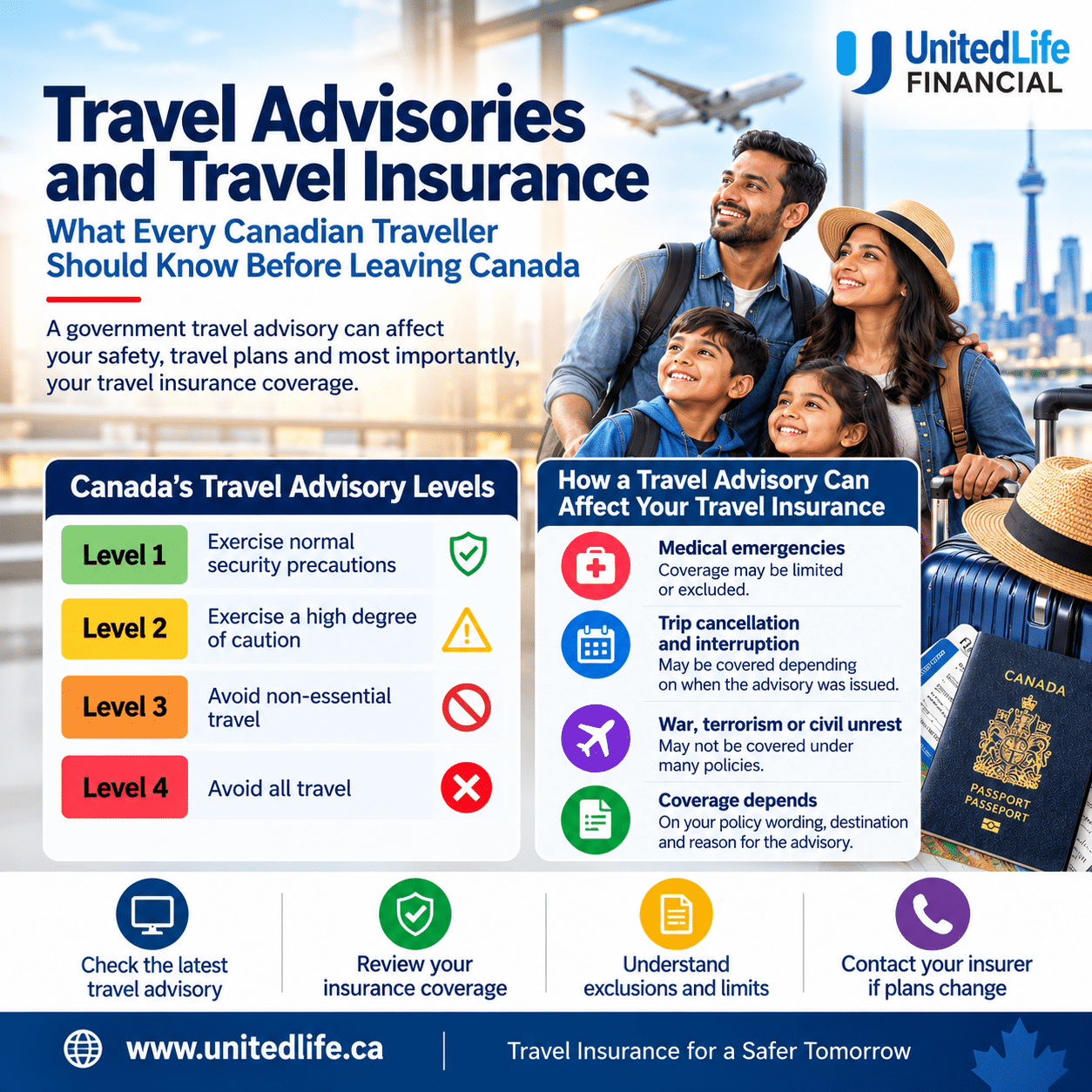
Understanding Canada’s Four Travel Advisory Levels
Level
Government advice
1
Exercise normal security precautions
2
Exercise a high degree of caution
3
Avoid non-essential travel
4
Avoid all travel
Levels 3 and 4 are particularly important when reviewing travel insurance coverage.
An advisory may apply to an entire country or only certain regions within that country.
How Can a Travel Advisory Affect Your Travel Insurance?
Many travellers assume that purchasing travel insurance means they are protected against every unexpected situation.
Unfortunately, this is not always the case.
Travel insurance policies have terms, conditions, limitations, and exclusions. Some policies contain specific exclusions related to government travel advisories.
1. Medical Emergency Coverage May Be Affected
Imagine you are travelling to a destination where the Government of Canada has advised Canadians to avoid non-essential travel.
During your trip, you experience a medical emergency and require hospitalization.
Depending on your policy wording, the insurer may exclude certain claims connected to the circumstances that led to the advisory.
For example, if a government advisory warns about civil unrest and you are injured during that unrest, your insurance coverage could be affected.
Important: A Level 3 or Level 4 advisory does not automatically mean that every medical claim will be denied. Coverage depends on the insurance company, the policy wording, when the advisory was issued, and the cause of the claim.
2. Trip Cancellation and Trip Interruption Insurance
Travel advisories can also affect trip cancellation and interruption benefits.
For example:
You book a family vacation several months in advance and purchase travel insurance.
A few weeks before departure, the Government of Canada issues a new Level 3 advisory for your destination.
Depending on the policy, this change may qualify as an insured reason to cancel your trip.
However, if the advisory was already in effect when you purchased your insurance or booked your trip, cancellation related to that known situation may not be covered.
Not all travel insurance plans include trip cancellation or interruption coverage. These benefits must be specifically included in your policy.
3. What Happens if an Advisory Changes While You Are Abroad?
Suppose you arrive at your destination when the travel advisory is Level 1 or Level 2.
A few days later, political unrest or another emergency causes the Government of Canada to raise the advisory to Level 3 or Level 4.
What happens to your insurance?
This depends on your policy.
Some insurance companies may provide a limited period of continued coverage, while others may have specific requirements concerning departure from the affected area.
Never assume your coverage will continue unchanged.
Contact your insurance provider immediately, review the updated advisory, and follow the insurer’s instructions.
4. War, Terrorism, and Civil Unrest Exclusions
Many travel insurance policies contain exclusions or limitations involving war, terrorism, civil unrest, or related events.
Even if you have purchased comprehensive travel medical insurance, certain claims resulting from these events may not be covered.
The wording differs between insurance companies, and some policies provide limited coverage under specific circumstances.
This is why reviewing your policy is just as important as comparing premiums.
Does Travel Insurance Cover Countries Under Level 3 or Level 4 Advisories?
There is no universal answer.
Some insurance companies may decline to provide certain coverage for destinations under high-risk advisories. Others may issue policies with specific exclusions.
The following factors can matter:
- The advisory level when you purchased your policy
- The advisory level when you departed
- Whether the advisory applies to your exact destination
- The reason for the advisory
- Whether your claim is directly or indirectly related to that reason
- The insurance company’s policy terms and exclusions
Buying a travel insurance policy does not guarantee that every risk at your destination is insured.
What Should You Do Before Travelling?
Before leaving Canada, we recommend these important steps:
1. Check the Government of Canada’s travel advisory.
Visit the official website:
https://travel.gc.ca/travelling/advisories
Search for your destination and review the current advisory, including regional warnings.
2. Review your travel insurance coverage.
Check your emergency medical coverage, exclusions, deductibles, trip cancellation benefits, and emergency assistance provisions.
3. Inform your insurance broker about your destination.
If your destination has an elevated travel advisory, discuss it before purchasing insurance.
4. Monitor travel advisories before and during your trip.
Conditions can change unexpectedly. Check for updates and consider registering with the Government of Canada’s Registration of Canadians Abroad service.
5. Keep your insurance information accessible.
Save your policy documents, emergency assistance telephone number, and policy number.
If you experience a medical emergency, contact your insurer’s emergency assistance provider as soon as reasonably possible.
Why Choosing the Right Travel Insurance Matters
Travel insurance should not be selected based on price alone.
Two insurance policies may offer the same emergency medical coverage limit but have very different exclusions, limitations, and benefits.
For example, a $5 million emergency medical insurance policy does not necessarily mean every medical expense up to $5 million will be covered.
The circumstances of the emergency and the policy conditions determine whether a claim is eligible.
An experienced insurance broker can help you compare different insurance companies, understand the coverage, and identify important exclusions before you travel.
How United Life Financial Can Help
At United Life Financial, we help Canadian residents and international travellers compare travel insurance options from multiple insurance providers.
Our travel insurance services include:
- Travel insurance for Canadians travelling abroad
- Emergency medical travel insurance
- Visitors to Canada insurance
- Super Visa insurance for parents and grandparents
- International student insurance
- Trip cancellation and interruption insurance, where available
We help clients understand their coverage options, including important limitations and exclusions.
You can also compare available plans and get instant insurance quotes through our website.
Final Thoughts: Check Before You Travel
Travel advisories are not just government warnings. They can also have important implications for your travel insurance.
Before booking your next international trip, take a few minutes to check the Government of Canada’s travel advisory and understand your insurance policy.
Remember: Having travel insurance is important. Knowing what your travel insurance actually covers is even more important.
Travel with confidence. Travel with the right protection.
Get a Travel Insurance Quote Today
United Life Financial
🌐 Website: https://www.unitedlife.ca
📞 Office: 905-906-7000
✉️ Email: info@unitedlife.ca
Compare multiple travel insurance plans and get instant quotes online.
Disclaimer: This article provides general information only and does not constitute a guarantee of insurance coverage. Travel insurance coverage, exclusions, eligibility, and claims decisions depend on the specific insurer and policy wording. Government travel advisories may change without notice. Always review your policy and confirm coverage with your insurance provider before travelling.