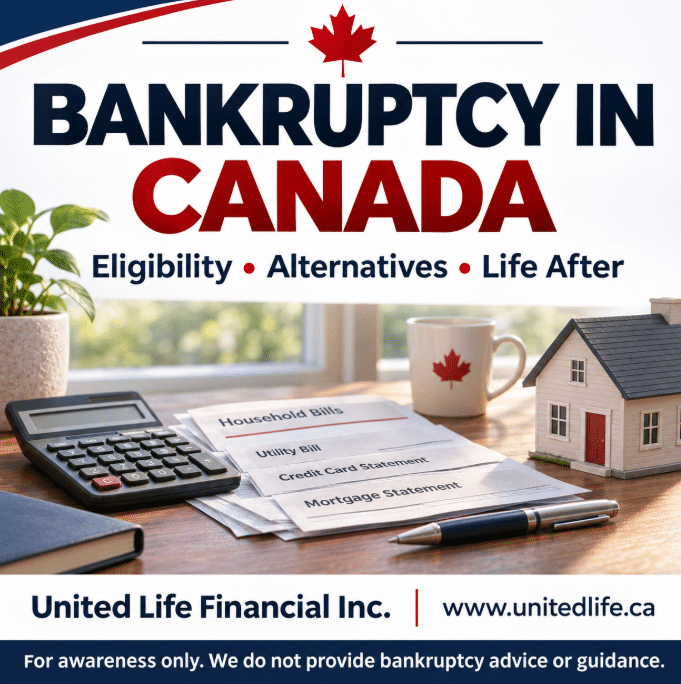
Struggling With Debt? Understand Bankruptcy Before Making a Decision
Debt can become overwhelming after a job loss, illness, separation, business loss, or rising household expenses. Sometimes, people keep making payments but see little improvement because interest continues to accumulate.
Bankruptcy may offer a legal way forward, but it has consequences—and other options may be available.
Why we are sharing this article: Our intention is to raise awareness and explain basic concepts so readers can have more informed conversations with qualified professionals.
United Life Financial Inc. does not provide bankruptcy, insolvency, debt settlement, or legal advice or guidance. We do not assess eligibility, recommend debt solutions, or assist with bankruptcy filings. For advice about your circumstances, consult a Licensed Insolvency Trustee or a qualified lawyer.
What is bankruptcy?
Personal bankruptcy is a legal process under Canada’s Bankruptcy and Insolvency Act. It can release a person from most debts they cannot repay, subject to legal requirements.
In exchange, the person must disclose their financial situation, complete required duties, and potentially surrender non-exempt assets or make payments.
A Licensed Insolvency Trustee (LIT) administers the process. Filing starts the bankruptcy; discharge is the later step that releases the person from most eligible debts. ised-isde.canada.ca
How does someone become bankrupt?
Financial difficulty and bankruptcy are different things. Missing a payment or receiving collection calls does not automatically make someone bankrupt.
People may reach financial difficulty because of:
- Reduced income or unemployment.
- Illness or disability.
- Separation or divorce.
- Business losses.
- High borrowing costs.
- Repeated borrowing to cover daily expenses.
A person may voluntarily file for bankruptcy through an LIT. Creditors can also apply to a court for a bankruptcy order when the legal conditions are met. www.canada.ca
Who may be eligible?
Generally, a person considering voluntary bankruptcy must:
- Reside, carry on business, or have property in Canada.
- Owe at least $1,000 in debts provable in bankruptcy.
- Meet a legal insolvency test—for example, being unable to pay obligations as they generally become due or having insufficient assets to cover their obligations.
The $1,000 threshold is a legal minimum, not an indication that bankruptcy is suitable. Eligibility and suitability require an individual assessment by an LIT. laws-lois.justice.gc.ca
What alternatives may be available?
Bankruptcy is one possible response to unmanageable debt. Other approaches include:
| Option | How it works | Important consideration |
|---|---|---|
| Creditor arrangements | A creditor may agree to revised payments or temporary relief | Participation and terms depend on the creditor |
| Debt consolidation | Several debts are combined into one loan | It does not eliminate the debt; the new payments must be affordable |
| Debt management plan | A credit counsellor helps arrange repayment | Generally requires repayment of the full principal; creditors may offer interest relief |
| Consumer proposal | An LIT submits an offer to repay part or all of the debt over an agreed period | Requires acceptance and completion of its terms |
| Bankruptcy | A formal process can release most eligible debts | May affect assets, required payments, and credit |
The appropriate option depends on income, expenses, assets, debt types, and repayment ability. ised-isde.canada.ca
What is a consumer proposal?
A consumer proposal is a legally binding process administered by an LIT. It offers creditors partial repayment, more time to repay, or both.
It is available to eligible individuals whose total debts do not exceed $250,000, excluding debts secured by their principal residence. Its term cannot exceed five years.
People generally retain their assets while meeting proposal terms and continuing necessary payments to secured creditors. A proposal still affects credit and should not be confused with an ordinary consolidation loan. ised-isde.canada.ca
Before bankruptcy: what needs to be reviewed?
An LIT needs a complete picture of the person’s finances, including:
- Income, household expenses, and dependants.
- Credit cards, loans, tax debts, and other obligations.
- Joint debts and personal guarantees.
- Property, vehicles, savings, investments, and insurance policies.
- Recent gifts, asset transfers, sales, or repayments to relatives.
Do not assume that transferring property to a family member will protect it. Recent transactions must be disclosed and may have legal consequences.
Retirement withdrawals also deserve careful review because some savings may already receive legal protection. ised-isde.canada.ca
Initial financial assessments with LITs are typically free. Be cautious of businesses promising guaranteed debt elimination or an immediate credit repair solution. www.canada.ca
During bankruptcy: what happens?
The trustee administers the bankruptcy, communicates with creditors, and assesses assets and payment obligations.
Most collection proceedings concerning debts covered by the bankruptcy are stopped, subject to legal exceptions. Secured creditors generally retain rights against their collateral.
The person must cooperate with the trustee, disclose required information, attend two financial counselling sessions, and complete applicable payments and duties. www.ised-isde.canada.ca
Does bankruptcy cost money?
Bankruptcy is not necessarily free, and there is no single cost that applies to everyone.
The financial impact depends on factors such as non-exempt assets and required surplus-income payments. Surplus income is assessed under federal rules using income and household circumstances; it is not simply whatever remains in a bank account at month-end. www.ised-isde.canada.ca
Will someone lose their house or car?
Not necessarily, but keeping them is not guaranteed.
Ontario law provides exemptions for certain necessities and assets, subject to conditions and prescribed limits.
For a home or vehicle, two separate issues may arise:
- The secured lender’s rights under the mortgage or loan.
- The trustee’s interest in any non-exempt equity.
Continuing loan payments does not, by itself, resolve the equity question. Joint ownership also requires individual review. www.ontario.ca
What happens to retirement savings and life insurance?
RRSPs and RRIFs generally receive federal bankruptcy protection, subject to an exception for contributions made within the preceding 12 months and other applicable rules. Not every registered account receives the same treatment. laws-lois.justice.gc.ca
Certain life insurance contracts may also qualify for creditor protection. In Ontario, this can depend on factors such as the policy arrangement and beneficiary designation.
Neither life insurance nor insurance-based investments should be described as automatically “bankruptcy-proof.” The actual contract and circumstances need review by the person’s trustee or lawyer. www.ontario.ca
Does bankruptcy eliminate every debt?
No. Important exceptions include:
- Child and spousal support.
- Certain court fines, penalties, and restitution orders.
- Certain debts arising from fraud.
- Government student loans that do not meet the applicable discharge rules.
Secured creditors generally retain their rights against collateral. www.ised-isde.canada.ca
For government student loans, the general rule is seven years after the person ceased being a full-time or part-time student, rather than seven years after borrowing. A court may grant hardship relief after five years when the legal conditions are satisfied. ised-isde.canada.ca
How long does bankruptcy last?
Typical automatic discharge timelines are:
| Bankruptcy history | Without surplus-income payment obligations | With surplus-income payment obligations |
|---|---|---|
| First bankruptcy | 9 months | 21 months |
| Second bankruptcy | 24 months | 36 months |
These timelines are conditional. Opposition, incomplete duties, and special circumstances can delay discharge. Third and subsequent bankruptcies require a court determination rather than automatic discharge. www.ised-isde.canada.ca
Will a spouse or co-signer be affected?
Marriage alone does not make a spouse responsible for the other person’s individual debts.
However, joint borrowers and co-signers remain responsible, and jointly owned assets require review. One person’s bankruptcy does not release another borrower from the same loan. ised-isde.canada.ca
After bankruptcy: can someone rebuild?
Yes, although discharge does not immediately remove the bankruptcy from a credit report.
For a first bankruptcy, Equifax generally removes the record six years after discharge. In Ontario, TransUnion generally retains it for seven years after discharge. Repeat bankruptcies remain longer. Filing also creates a public insolvency record. www.canada.ca
Rebuilding involves manageable spending, timely payments, careful borrowing, and reviewing credit reports for errors. Future approval depends on the lender; no one can guarantee an immediate mortgage, credit card, or restored credit score. ised-isde.canada.ca
Where can readers get qualified help?
A Licensed Insolvency Trustee can assess a person’s finances and explain formal insolvency options. A qualified lawyer can advise on legal issues such as ownership disputes, guarantees, and transactions involving assets.
This article is published by United Life Financial Inc. solely for general education and awareness. We do not provide guidance or services relating to bankruptcy, insolvency, debt settlement, or legal matters. Reading this article does not establish an advisory relationship concerning these subjects.
This article discusses personal bankruptcy in Canada, with Ontario examples. It does not cover corporate bankruptcy. Laws, exemptions, and outcomes depend on the circumstances and may change.