Your Advisor Said Pay for 20 Years. Your Insurance Policy Says YRT. Who Is Right?
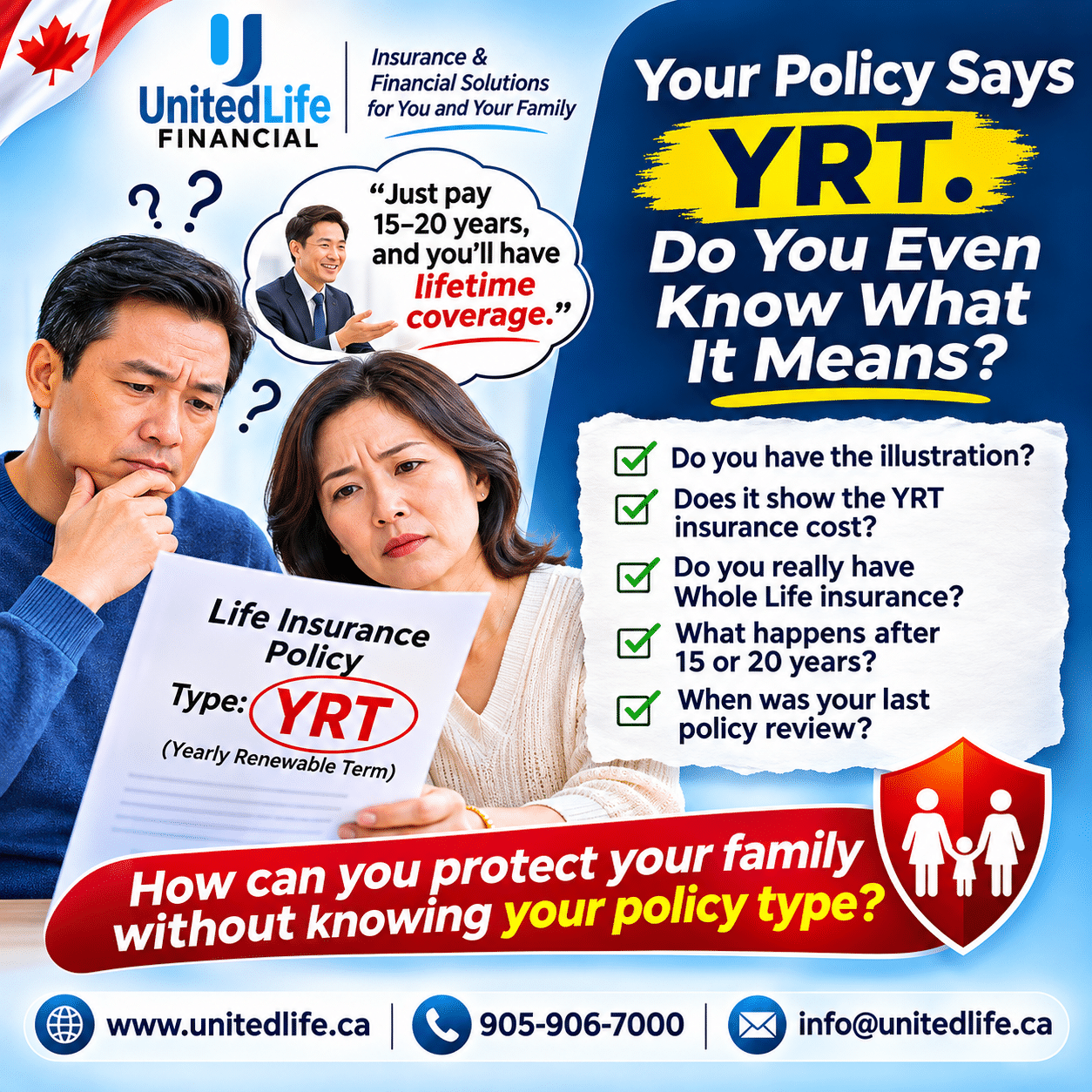
Your Life Insurance Policy Says YRT. Do You Even Know What It Means?
Your advisor said, “Just pay for 15 or 20 years, and you will have life insurance for the rest of your life.” But is that what your policy actually guarantees?
You purchased life insurance to protect your family. You have been paying your premiums regularly, believing you have whole life insurance.
But have you ever opened your policy and checked what you actually purchased?
What if your policy says YRT — Yearly Renewable Term?
Do you understand what that means for your future?
You Think You Have Whole Life Insurance. But Do You?
Some Canadians purchase Universal Life insurance with a YRT cost of insurance structure without fully understanding how it works.
There is a significant difference between Whole Life insurance and Universal Life insurance with YRT.
Both can provide lifetime protection, but their costs, guarantees and funding requirements can be very different.
Just because your policy provides permanent coverage does not mean your premiums are guaranteed to stop after 15 or 20 years.
What Is YRT in Life Insurance?
YRT stands for Yearly Renewable Term. In a Universal Life insurance policy, it generally means that your underlying cost of insurance increases as you get older.
Your monthly payment may remain the same, but the amount the insurance company deducts internally for insurance coverage can increase.
When you are younger, the insurance cost may be relatively low. As you age, it can become significantly higher.
If your policy’s investment account does not have sufficient funds to cover these costs, you may need to contribute additional premiums to keep your coverage active. Otherwise, your policy could eventually lapse.
Your Advisor Said You Only Need to Pay for 20 Years. Is It Guaranteed?
There is a big difference between:
- Paying premiums for 20 years under a guaranteed limited-pay insurance contract.
- Planning to fund a Universal Life policy for 20 years based on projected investment returns.
One may be a contractual guarantee. The other may depend on assumptions.
What happens if investment returns are lower than expected?
What happens if your account value is insufficient to cover future insurance costs?
Could you afford additional premiums at age 65, 75 or 85?
These are questions you should ask before purchasing the policy, not after retirement.
Where Is Your Insurance Illustration?
Do you have a copy of your original insurance illustration?
Even if you have one, does it clearly show your annual YRT cost of insurance?
Can you identify:
- Your policy type and cost of insurance structure?
- Your future annual insurance costs?
- Guaranteed and non-guaranteed values?
- Assumed investment returns?
- What happens if investment performance is poor?
- Whether stopping premiums after 15 or 20 years is guaranteed?
An illustration showing attractive future cash values is not enough. You should also understand the costs and risks behind those numbers.
An illustration is not a guarantee. Your insurance contract determines your guarantees.
Is YRT Always a Bad Choice?
Absolutely not.
YRT can be a suitable insurance strategy when it is properly designed, adequately funded and regularly reviewed.
The problem is not necessarily YRT. The problem is purchasing YRT without understanding YRT.
A responsible advisor should explain both the benefits and the risks, show you different scenarios and prepare you for the possibility that things may not go as planned.
You should understand the worst-case scenario, not just the best-case illustration.
Your Advisor Met You Many Times Before You Purchased Insurance. How Many Times After?
Think about it.
Your advisor may have spent hours explaining the benefits, showing presentations and encouraging you to purchase the policy.
But after you purchased it:
- How many annual policy reviews have you received?
- Has anyone reviewed your actual investment performance?
- Has anyone checked whether your policy is adequately funded?
- Has anyone explained your increasing insurance costs?
- Has anyone checked whether your coverage still meets your family’s needs?
Selling a policy is one thing. Servicing it for decades is another.
Can You Guarantee Your Advisor Will Be With You Forever?
Your insurance policy may be designed to last a lifetime.
But your advisor may retire, change careers, move to another company or stop working in the insurance industry.
That is why you must understand your own policy.
You do not need to become an insurance expert. However, you should know what you own, what is guaranteed, what is not guaranteed and what could go wrong.
Your advisor may not be there when your family needs the insurance. Your policy needs to be.
How Can You Protect Your Family Without Knowing What You Purchased?
Life insurance is one of the most important financial decisions you make for your family.
Do not purchase insurance simply because someone told you that it is the best plan, an investment opportunity or a policy you only need to pay for 20 years.
Ask questions. Understand the guarantees. Request the illustrations. Review your policy regularly.
Your family’s financial protection should not depend on assumptions.
Already Have Life Insurance? Ask Yourself These Seven Questions.
- Do I know what type of life insurance I have?
- Does my policy have YRT or Level Cost of Insurance?
- Do I have a complete copy of my insurance illustration?
- Do I know how much my insurance will cost in the future?
- Is my premium payment period guaranteed?
- What happens if my investment returns are lower than expected?
- When was my last insurance policy review?
If you cannot confidently answer these questions, it may be time to review your policy.
Get Your Existing Life Insurance Policy Reviewed
At United Life Financial, we believe that understanding your insurance is just as important as purchasing it.
Whether you have Whole Life, Universal Life, YRT, Level Cost of Insurance or Term Life insurance, understanding your existing coverage can help you make informed financial decisions.
A policy review does not necessarily mean replacing your existing insurance. In many cases, keeping or adjusting your existing policy may be the right decision.
Never cancel an existing life insurance policy without understanding the consequences and consulting a licensed insurance advisor.
Contact us to better understand your life insurance policy.
United Life Financial Inc.
Website: https://www.unitedlife.ca
Phone: 905-906-7000
Email: info@unitedlife.ca
Understand before you buy. Review after you buy. Protect your family with confidence.
Disclaimer: This article is for general educational purposes. Insurance costs, guarantees, funding requirements and policy provisions vary by insurer and contract. Consult a licensed insurance advisor before making changes to an existing policy.